![Aluminum Anodizers Council [AAC]](https://www.anodizing.org/wp-content/uploads/2023/02/aluminum-anodizers-council.webp)
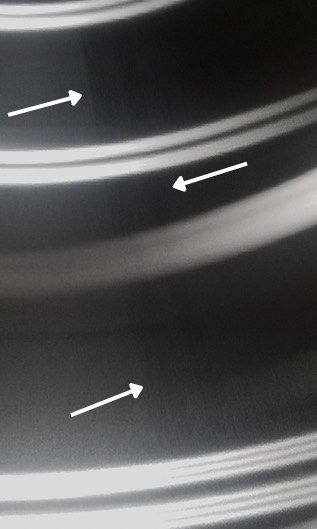
Segregation Streaking
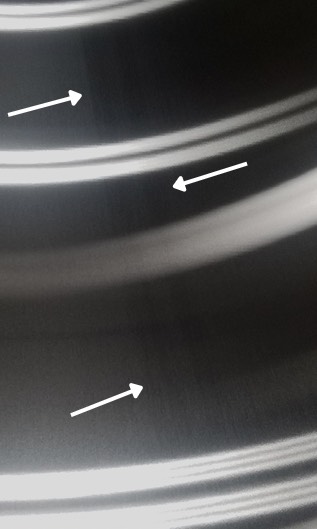
Figure 1: Raw Streaking Material

Figure 2: Etched Finish with Light Streaks
| Defect Name | Segregation Streaking (Sheet) |
|---|---|
| Anodize Type | Type II, Type III |
| Defect Type | Metallurgical |
| Origin of Defect | Extruder Conditions |
| Specific Cause of Defect | Separation of the alloying ingredients |
| Identifier | Dark or light streaks along grain line of sheets |
| Identifier Location | Post etch |
| Testing Method(s) | Etch tank test, visual inspection |
| Immediate Fix | Contact customer or review quality metrics |
| Preventative Fix |
Discuss quality review and lot tracking with customer. Work with supplier for preventative action. |

Figure 3: Etched Finish with Dark Streaks
Indicator
The structural streaking can be found in both extrusions and sheet material. The streaks are not usually visible until after anodizing, this is not always the case and a slight dark patch may be visible on the surface. The streaking may also be noticed if an extrusion is placed in an etch bath and the etch unevenly or activated on the surface. Most anodizers will notice a coloration difference between the etch rinse and the deox. The streaking will typically be in line with the direction of the grain.
Immediate Fix
This cannot be fixed by the anodizers. Discussion with the customers on their quality requirements will determine next steps.
Preventative Fix
Reviewing Head and Tail Samples of the coil to check for streaking can help, but the problem can start and stop midway through the coil. The streaking can also continue through the entire coil, so lot inventory and tracking will be critical to identifying and isolating a coil that has streaking.
Close inspection of the parts can catch some of the streaking, but each coil will be unique.